
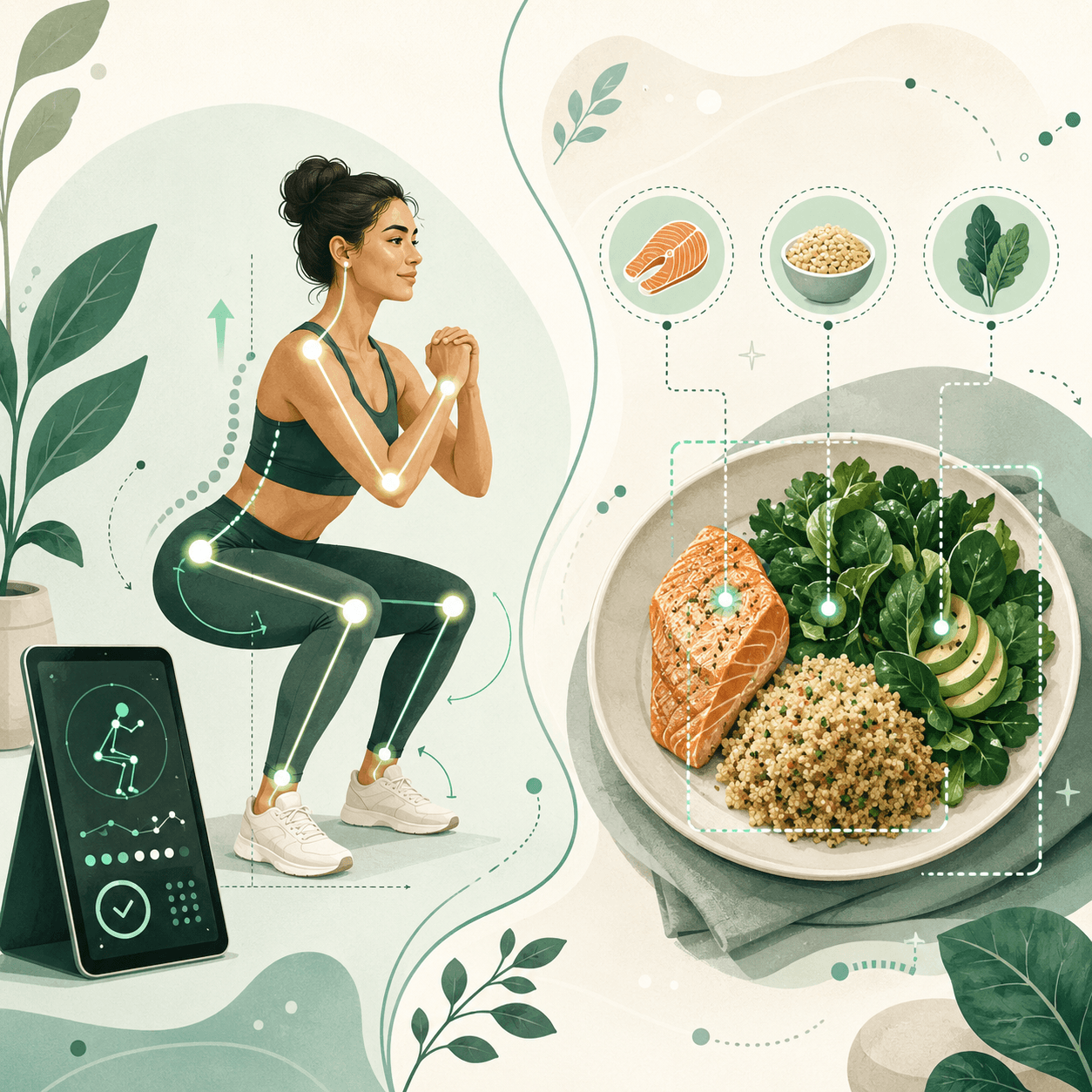
The camera is becoming the personal trainer
Form checks, rep counting, meal logging from a photo — the fitness apps winning right now ship features that watch and understand. We build them at $12,000–$15,000+, and we do it without the magic-AI overpromising: every project starts with a discovery sprint that establishes what’s achievable before anyone quotes anything.
The use-case gallery
Four features — and what each honestly takes to build
Every card carries a “the honest part” line. If a vendor pitches you one of these features without it, that’s the tell.
Pose estimation & form feedback
“Is my squat depth right?” — answered by the camera.
Mature pose models provide the skeleton; the real work is exercise-specific joint-angle logic, feedback that coaches instead of scolds, and handling occlusion when a knee disappears behind a barbell.
The honest part — Works best with a full-body view and decent lighting. The feature must know when it can't see enough — and say so.
Rep counting
Automatic counting from movement cycles — no tapping mid-set.
Runs on-device for real-time response. Needs per-exercise motion signatures and tolerance for partial reps, pauses and camera wobble.
The honest part — Near-perfect on distinct movements like squats and push-ups; harder on subtle lifts. We tell you which of your exercises are which before you commit.
Food photo recognition & logging
Point, shoot, logged — removing the friction that kills nutrition tracking.
Recognition plus portion estimation plus a nutrition database mapping. The UX for fast manual correction matters as much as raw model accuracy, and it's where logging retention is won.
The honest part — Single common foods: strong. Mixed home-cooked dishes and portion size: genuinely hard. Design assumes correction, and gets better from it.
Body composition & progress tracking
Guided progress photos that make slow change visible.
Pose-guided capture for consistent framing, alignment and comparison over time, on-device processing for privacy where possible.
The honest part — A motivation tool, not a medical measurement — and the product language has to respect that line. We build it in from the start.
The process
Discovery before quote — always
Computer vision quotes given on a sales call are fiction — the cost lives in questions a call can’t answer. The AI/ML Discovery sprint answers them in five days, and if the honest answer is “this feature isn’t worth building yet,” you hear that too. For $1,500, not $15,000.
Data reality check
What training and evaluation data exists, what can be collected, and what the gap means for accuracy and timeline.
Accuracy expectations, in writing
What the model can realistically achieve for your exercises, foods or framings — the number the product gets designed around.
On-device vs server trade-off
Latency, privacy, model size, infrastructure cost — settled with your actual use case, not a default.
A scoped plan and a real quote
Architecture, milestones and a price grounded in the above. Credited in full if we build it.
The credibility section
CV models have error rates. Great products are designed for them.
No vision model is right 100% of the time — in the gym’s bad lighting, with the camera propped against a water bottle, it’s not close. The difference between a feature users love and one they mock in reviews is what happens in the error cases.
Confidence-aware UX
Below an agreed confidence threshold, the app asks instead of asserts — “Was this a squat?” beats confidently logging the wrong movement. Uncertainty handled gracefully reads as intelligence, not weakness.
Correction as a feature
One-tap fixes for a miscounted rep or a misidentified meal, designed into the core flow. Users forgive mistakes they can fix in a second — and every correction is signal for making the model better.
Graceful degradation
Poor lighting, partial framing, an unsupported exercise: the feature steps back to manual mode with an honest message instead of guessing. The product keeps working when the model can't.
Questions founders ask
Before you scope a CV feature
Our competitors already ship form-check. How far behind are we?
Less than it feels. The underlying pose-estimation models are mature and available — the differentiating work is the exercise-specific logic, the feedback UX, and honest handling of the cases where the camera can't see enough. That's weeks of focused work after discovery, not the multi-year research project it looks like from outside.
Why is discovery mandatory before you'll quote?
Because CV project costs are driven by things a sales call can't surface: what data exists, what accuracy the feature genuinely needs, and whether inference belongs on-device or on a server. The AI/ML Discovery sprint ($1,500, 5 days) answers those questions and produces a scoped plan with a real quote. It's credited toward the project, so it costs nothing extra if you proceed — and it's the reason our CV quotes don't double mid-build.
How accurate will pose detection or food recognition actually be?
Honestly: it depends, and anyone who quotes a number before discovery is guessing. Pose estimation is strong on well-lit, full-body framings and degrades with occlusion, loose clothing and odd camera angles. Food recognition identifies common single foods well and struggles with mixed dishes and portion size. Discovery establishes achievable accuracy for your specific use case — and the product is then designed around that truth rather than a demo-day fantasy.
On-device or server — which will our feature use?
It's a trade-off we settle in discovery. On-device gives you real-time feedback, offline use and no video leaving the phone (a genuine privacy win for a fitness app) at the cost of model size and device-performance constraints. Server-side gives heavier models and easier iteration at the cost of latency, infrastructure spend and shipping user video to a backend. Rep counting and form feedback usually want on-device; food recognition often tolerates server-side.
What happens when the model gets it wrong in front of a user?
That's a design question, and we treat it as seriously as the model itself. Good CV features degrade gracefully: confidence thresholds below which the app asks instead of asserts, easy manual correction that feeds future improvement, and honest UI language. A rep counter that's occasionally one off but easy to correct keeps users; one that confidently miscounts loses them.
Is body-composition tracking from photos medically valid?
No, and your app shouldn't claim it is. Photo-based body tracking is a motivational consistency tool — same pose, same lighting, visible change over time — not a clinical measurement. We build it with that framing, and if your roadmap wants claims beyond it, that crosses into validated-measurement territory that needs specialist oversight. We'll flag that boundary before you build, not after.
Related services
Around the model
Let’s create together
Want form-check without the vaporware?
Tell us the feature and the app it lives in. Discovery will tell you what's achievable, what it costs, and whether it's worth building — honestly, in five days.